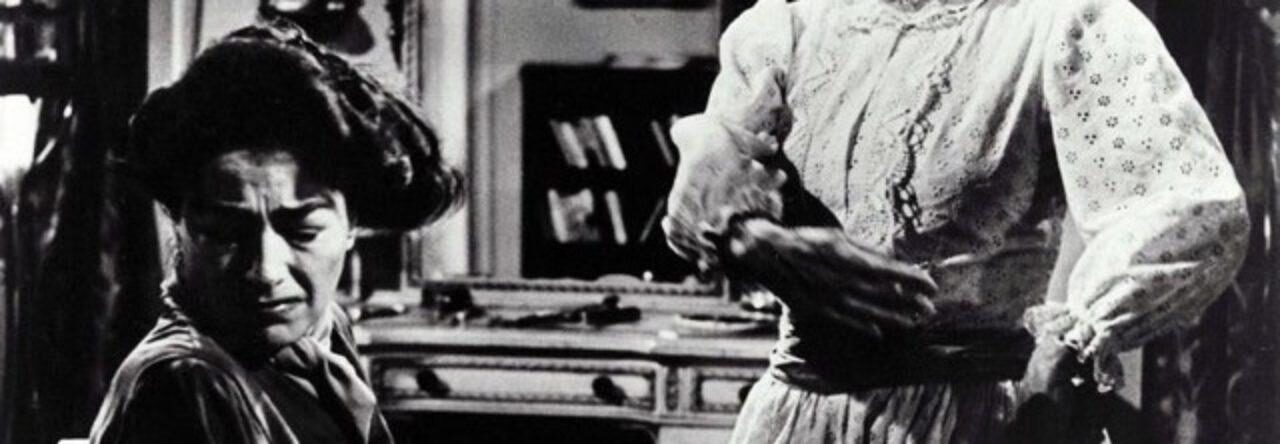
Look what the homosexuals have done to me!

Author: Cranky Lesbian Page 16 of 54

Cranky Lesbian is a disgruntled homosexual with too much time on her hands. Click for film reviews or to follow on Instagram.

Somewhere Over the Rainbow

I don’t have many prized possessions, but this old poster follows me wherever I go. Judy at Carnegie Hall is one of those albums, like Pet Sounds, The Queen is Dead or Sweet Old World, that helps make life more understandable and more bearable. Today, to commemorate Judy Garland’s centennial, I’ll listen to it “and swing it from Virginia/to Tennessee with all the love that’s in ya.” And I’ll also look for time to rewatch The Clock, my favorite Garland film, this weekend.

In keeping with the spirit of this website, I did a little digging to see if Garland’s younger daughter, Lorna Luft (of Grease 2 fame), had any TV movie credits. Behold, the poorly titled Fear Stalk from 1989, by director Larry Shaw. (I enjoyed his Mother Knows Best but wasn’t as keen on The Ultimate Lie.) The plot sounds rather thin: a purse thief stalks a producer in Beverly Hills.

“JAAAAA!”

Victory is sweet.

Do I think Casper Ruud actually screamed “JAAAAA!” at Holger Rune in the locker room after their Roland-Garros semifinal clash? No. But did I yell it in my living room after Iga Świątek won her second major title today? Yes.

And then I retrieved from the freezer the same pint of ice cream I’d tossed in the grocery cart during a Ben & Jerry’s sale four weeks earlier. “This is for when Świątek wins the French,” I told my disinterested wife that day. For Wimbledon maybe I’ll mix things up and get some cookie dough ice cream instead.

Tomorrow I hope to celebrate a Coco Gauff win in doubles, and for Rafael Nadal to further extend his lead in Grand Slam singles titles over Novak Djokovic. As a Federer purist whose second-favorite player for many years was Djoker, that’s a strange situation to find oneself in. But Djokovic’s attitude of late has made him difficult to support, and I think there’s a decent chance Nadal retires before the end of the weekend, so let’s make hay while the sun shines.

Barbara Stanwyck Charges Ten Cents a Dance

Some would call ten cents a bargain.

It’s not every day that you dust off a 1931 pre-code Barbara Stanwyck film because of a ’90s-era Cheryl Ladd TV movie, but I wouldn’t mind if it happened more often. While toiling on an upcoming post about Ladd’s Dancing with Danger (1994), in which she played a taxi dancer, I was reminded of Stanwyck’s turn as a woman in the same profession in Ten Cents a Dance.

Stanwyck is my favorite American actress. This is a play on the possibly apocryphal Clifton Webb quote about her (“My favorite American lesbian,” discussed more below), but it’s also the truth. Behind my desk is a framed original insert poster for There’s Always Tomorrow, and I own nearly all of her films that have been released on DVD. When, years ago, I cheekily volunteered to die for assorted femme fatales, Stanwyck didn’t make the list. That’s because I would’ve been a comically dazed Henry Fonda in her presence, not a Fred MacMurray.

Ten Cents a Dance is one of her least scandalous pre-code films, and has strange origins. It is, as the credits note, “based upon the popular song by Lorenz Hart and Richard Rodgers.” Stanwyck plays Barbara O’Neill, a young woman with dim prospects employed at the Palais de Dance. When a crude, tobacco-chewing sailor asks “What’s a guy gotta do to dance with you gals?” Barbara replies with half a sneer, “All you need is a ticket and some courage.” Her irritation is palpable as he drags her across the floor.

French Open Highlights and Kasatkina’s Gay Q&A

Mary Carillo: “Je vois la vie en clay.”

Tournament Highlights

What a great French Open this has been so far, scheduling snafus aside. And we still have the women’s semifinals and finals to go, while the men wrap up their remaining quarterfinals (I’m hoping Cilic and Ruud win theirs). Among the highlights:

  • The emotional retirement ceremony of Jo-Wilfried Tsonga, one of my favorite ATP players, at his home tournament.
  • Gille Simon’s magical late-night first-round upset of Pablo Carreño Busta. Simon, who will retire at the end of the season, could barely stand as the fifth set drew to a close but was carried along by a rapturous home crowd while his excited kids watched from the stands.
  • Carlos Alcaraz’s 131 mph overhead bomb that fueled his second-round comeback against Albert Ramos-Viñolas.
  • Nadal’s quarterfinal victory over Djokovic, which wasn’t as close as the fourth-set scoreline might suggest.
  • Daria Kasatkina’s run to the semifinals. She’s a stealthy all-surface threat who is often overlooked by commentators due to her weak serve. She had a favorable draw at Roland Garros this year and made the most of it. (For those of you who found this page by searching for “Kasatkina lesbian,” click this post, scroll down a bit, and we’ll get to that.)
  • The ascendance of both Coco Gauff and Italy’s Martina Trevisan, a journeywoman who is radiant both on the court and in her writing. I found this piece about her recovery from an eating disorder quite moving (here’s an English translation). My wife battled anorexia for a very long time. She, like Trevisan, shares her story widely in hopes of helping others, and it takes a lot of guts to do it. The worst part of a Gauff/Trevisan semi is I’d like them both to win.
  • Iga Świątek continues to not only kick ass but to comport herself exactly as you’d expect from someone whose head is always in a book, whether she’s forgetting her age or experiencing chronic confusion about whether it’s a changeover.
  • Updated to add: Ruud just prevailed over the homophobic assclown Rune, and Rune barely shook Ruud’s hand at the net afterward, prompting Ruud to shake his head at his opponent’s immaturity. My wife, who has heard me complain about Rune before, looked up from her phone to joke “Would’ve been kind of funny if Ruud had said ‘Allez, f*ggot.'” (When Rune got in trouble for using anti-gay slurs, he claimed it was self-directed.)

RIP, Bo Hopkins

Most obituaries for actor Bo Hopkins, dead at 84, will mention American Graffiti, The Wild Bunch and his baffling Dynasty arc as Matthew Blaisdel. Like many homosexuals who watch too much television, I will remember him fondly for his guest appearances that reliably made shows like Murder, She Wrote and Charlie’s Angels a little bit weirder, if only for a few moments at a time.

And, more than anything, I will treasure his unusual performance in A Smoky Mountain Christmas (1986), the Dolly Parton musical-fantasy classic directed by Henry Winkler. A film that defies both description and sobriety, you either understand its brilliance or you don’tit’s the El Topo of made-for-TV movies. Hopkins plays a role of some importance, that of a sheriff who jails Parton and is mixed up in a bad romance with a vengeful mountain witch (Anita Morris, whose wig is as sublime as her performance). If you’ve not yet seen it, you have a new weekend assignment.

Weekend Viewing: Roland-Garros Begins

“Voulez-vous coucher avec tennis?”

After all the excitement of our Mother’s Day Marathon, what with Patty Duke terrorizing her family, Loni Anderson whoring around, Elizabeth Montgomery’s sundry acts of deviousness, and Stockard Channing dramatically vowing not to help her daughter become a lesbian, I took a little break to watch a bunch of tennis.

From my couch I savored every dazzling moment of Carlos Alcaraz’s triumph in Madrid and Iga Świątek’s ruthless brilliance in Rome. My wife, a Tolkien fanatic who is about as interested in tennis as I am in Middle-earth, took notice of Świątek’s dominance and asked what “bagels” and “breadsticks” were in tennis parlance, and then dutifully sent me memes such as this:

A Mother’s Homophobia in The Truth About Jane

Stockard Channing rejects her daughter in The Truth About Jane.

Being a gay teenager wasn’t particularly easy in 2000—ask me how I know! When Lifetime decided to examine the subject (two years after Jean Smart’s husband tumbled out of the closet in Change of Heart), it was appointment viewing for me. At the time, it felt underwhelming. It was a “message” movie and the conflicts were so easily, if imperfectly, resolved. At my house, it took much longer than 87 minutes for the arctic chill between a lesbian high school student and her conservative parents to thaw.

Revisiting The Truth About Jane as an adult perilously close to middle age, how differently would I feel? It turned out I liked it quite a bit more. Distance had dulled all the edges that were too sharp back then. I appreciated the clarity, and simplicity, with which writer-director Lee Rose captured what it was like to come out as a kid in the late ’90s/early aughts. And the homophobia of Stockard Channing’s character was much funnier to me than it had been back then, for reasons we’ll get to later.

My Mother’s Secret Life … as an Escort

Loni Anderson (un)dresses for success in My Mother’s Secret Life.

The big daughter-seeks-birth-mom TV event that everyone remembers from 1984 is, of course, the miniseries Lace. History has unfairly forgotten My Mother’s Secret Life, and I’ll be pleased if I can get even one person to revisit it. It’s an engaging (and unintentionally funny) telefilm that is perhaps best described as “Loni Anderson’s Charlene moment.” I encourage everyone to get in the mood right now by listening to the song of which I speak.

Now that we’ve taken the hand of a preacher man and made love in the sun, I think we can continue. My Mother’s Secret Life opens with Anderson’s Ellen Blake draped in about 30 lbs of designer clothes and furs. It’s all soon to be removed with artful precision in a demanding john’s penthouse suite. “I’m the buyer here,” he tells her aggressively. “I want to know what I’m buying. You do come at a premium rate.”

Elizabeth Montgomery’s Sins of the Mother

Elizabeth Montgomery raises a toast to an appalling lack of boundaries in Sins of the Mother.

If ever a film review deserved the headline “Bebitched,” it is Elizabeth Montgomery’s Sins of the Mother (1991). Adapted from Jack Olsen’s true crime novel Son: A Psychopath and His Victims, Sins does for motherhood what Montgomery’s The Legend of Lizzie Borden (1975) did for daughters.

Wooing her son one minute, tearing him to shreds the next, her Ruth Coe has the colorful vocabulary of Moira Rose; the histrionic tendencies of Rose and Lucille Bluth; and enough sinister Cluster B features to fuel an HBO limited series. On a cinematic scale of mother-son immorality, ranging from Psycho to Savage Grace to Ma Mère, Ruth’s relationship with son Kevin (Dale Midkiff of Back to You and Me) is mercifully mild. They are, in some ways, a more respectable version of con artists Lilly and Roy from The Grifters.

Please Don’t Hit Me, Mom Spotlights Abuse

Patty Duke and son Sean Astin costar in Please Don’t Hit Me, Mom

TV movie titans collide in Please Don’t Hit Me, Mom (1981), an Afterschool Special starring Patty Duke and Nancy McKeon. It begins in the typical style of such films, with McKeon’s Nancy Parks comically flying over the handlebars of her bicycle. Sprawled on the ground, she’s introduced to brothers Mike and Brian Reynolds (Lance Guest and Sean Astin). In the rare meet cute that intersects with child abuse, Nancy and Mike learn they’re new neighbors and will attend the same high school.

While the teenagers make eyes at each other, Barbara Reynolds (Patty Duke) angrily drags the younger Brian inside. The camera rests on the home’s exterior as she yells at him. We feel unsettled, a condition that extends to Nancy’s conversation with BFF Judy (Deena Freeman) about prom wear. “I blew my clothes allowance this month on a fantastic sweater,” Nancy admits. “So what do I wear to the prom?” She envisions unaffordable designer jeans.

Page 16 of 54

Powered by WordPress & Theme by Anders Norén