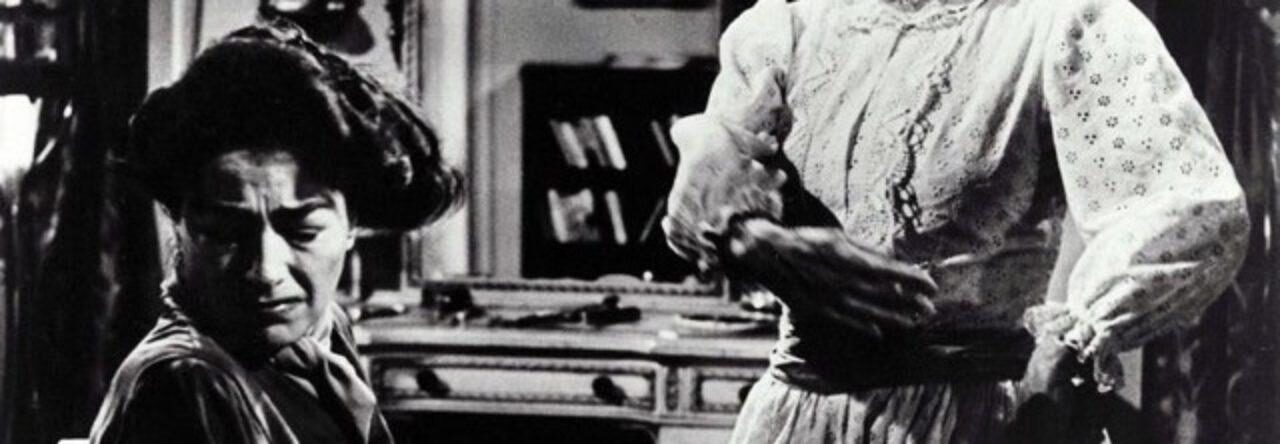
Look what the homosexuals have done to me!

Author: Cranky Lesbian Page 12 of 54

Cranky Lesbian is a disgruntled homosexual with too much time on her hands. Click for film reviews or to follow on Instagram.

A Stranger Among Us: What’s New and Exciting?

Melanie Griffith and Eric Thal are drawn to the unfamiliar in A Stranger Among Us.

The early ’90s brought viewers an unusual one-two punch from Sidney Lumet—unusual because the veteran filmmaker only managed to knock himself out. A Stranger Among Us (1992) and Guilty as Sin (1993) are the pictures in question, the former starring Melanie Griffith and the latter her then-husband, Don Johnson. That I recognize each as a dud does nothing to lessen my affinity for them, especially A Stranger Among Us, which bravely asks and answers the question: “What if we remade Witness with Hasidic Jews and cast Eric Thal as Kelly McGillis… and it sucked?”

Griffith plays Emily Eden, a flirty NYPD detective who jokes of her cowboy reputation that she’s Calamity Jane. (Our first hint that this was a questionable undertaking came in the form of its original title: Close to Eden.) Stranger opens with Emily and her partner Nick (Jamey Sheridan, adrift in a role that’s more conceit than character) reminiscing about both their first collar and their on-again, off-again relationship. “Cha-cha all night and then straight to the courthouse in the morning,” she recalls, before spotting a couple of sleazy perps she wants to take down without backup.

“God, It’s Killing Me”: Federer’s Final Match

You can all decide which of the Big Four are represented here as you please. I think Roger’s Dorothy and Rafa’s Trudy.

The match is over. Federer’s competitive career is over. The way he chose to go out, playing alongside Rafael Nadal, his fiercest rival and close friend—and in a team setting, no less (his European Laver Cup team also included the rest of the ‘Big Four,’ Novak Djokovic and Andy Murray)—was perfect.

People joke about Federer’s egocentrism because he’s so matter-of-fact in discussing his accomplishments. But the enormous respect and remarkable friendship he shares with Nadal, and their abiding belief that no one player is bigger than the sport, is a moving testament to the character of both men.

Nearly a half-hour after the post-match ceremony ended, my heart still feels as though it’s gripped in a vise. I had a hard time on the night of Serena’s retirement, but this was markedly worse for reasons that are impossible to articulate. Few things in my life ever meant as much to me as watching Roger Federer play tennis.

Dixie Carter Sings the Springsteen Songbook

Roger Federer’s final competitive match, a doubles pairing with Rafael Nadal, will be underway shortly at the Laver Cup, as soon as Andy Murray’s clash with Alex de Minaur concludes. I’ll turn up the television’s volume once Federer takes the court, but until then I’m trying to distract myself with music and, while perusing my tablet, landed on Bruce Springsteen.

Today is Springsteen’s 73rd birthday, a shocking number to a kid who grew up in the ’80s and still thinks of him as the energetic young rocker whose tight ass (her words, not mine) my token straight aunt ardently admired. In my younger days I listened more to his earlier work, and even crooned “Rosalita” to a girlfriend who indulged such nonsense despite my inability to carry a tune in a bucket.

As a woman lurching uncertainly toward middle age, I prefer his ’80s output, some of which—like “Brilliant Disguise” and other tracks from Tunnel of Love—is far more devastating to 39-year-old ears than it was to a clueless 20-something. My favorite Springsteen song comes from that decade: “I’m on Fire,” also known as “the creepy one.”

The Cat Creature Pussyfoots Around Lesbianism

Gale Sondergaard has designs on Renne Jarrett in The Cat Creature.

Where to begin with all of the metaphorical lesbian double-entendre that director Curtis Harrington cheekily supplies in The Cat Creature (1973)? And how to explain that some of it was purely unintentional, as the openly gay Harrington had no way of knowing then that Meredith Baxter was not quite the woman that networks — and viewers — imagined her to be. (And then there’s the smaller matter of her hunky love interest, David Hedison, whose lookalike daughter Alexandra became one of Hollywood’s most visible A-list lesbians in a time when there were few.)

This pulpy tale, adapted by Psycho author Robert Bloch from his own material, is thin on story and long on atmosphere. It begins with appraiser Frank Lucas (Kent Smith) recording a voice memo for the attorney that hired him to inventory a wealthy and secretive dead man’s estate. “This place gives me the shivers,” he says of the darkened mansion before descending into its cellar, which contains a priceless collection of ancient artifacts. Prying open a sarcophagus, he finds a mummy wearing a striking gold amulet with emerald eyes.

Hanging Around in the Lost and Found

Do you recognize this commemorative Elvis Pez display? There’s someone who might see this one day and recall it was a gift from a beloved relative. I was told to toss it out several years ago, when he was still alive, but hesitated because of its sentimental value.

It’s still sealed, moved houses with me, and is dusted like clockwork every Monday. It’s kept far away from peanut butter and bananas for obvious reasons. Earlier this year I meant to bring it up if we got in touch and those plans went awry. Should you see this and decide you want it, track me down and I’ll get it to you or one of his other survivors if they’d like it. I’m posting this now in case Federer’s retirement spurs you to check in.

For everyone else, I’ll be back later this week with a special telefilm review inspired by a reader email and there’s still more Golden Girls and Charlie’s Angels on the way.

Federer’s Long Goodbye

Longtime readers know how I feel about Roger Federer. Newer readers know how I feel about Roger Federer. Alien life forms probably know how I feel about Roger Federer.

My phone buzzed this morning with a few messages from people wondering how I was “handling the news,” somber phrasing that initially alarmed me. Had someone died? Announced a terminal diagnosis? Fortunately, it was nothing that dire.

Federer had finally acknowledged what was widely suspected already, that he was retiring after next week’s Laver Cup. Months ago, when Federer posted a ‘delfie’ with his family’s newly adopted dog, I felt certain it was over. The player who famously traveled the globe with a wife and two young sets of twins was now comfortably settled at home. It was a logical progression.

Tricks of the Trade: Laverne & Squirrelly

Markie Post and Cindy Williams stare nervously at criminals who aren't pictured.
Markie Post and Cindy Williams in Tricks of the Trade.

“They don’t teach Prostitution 101 at Vassar,” prim Beverly Hills housewife Cathy (Cindy Williams) huffs to streetwise hooker Marla (Markie Post) in Tricks of the Trade, a saucy 1988 telefilm. This very dated buddy comedy serves as her crash course. When stockbroker Donald (John Ritter), Cathy’s husband, is gunned down at Marla’s seedy apartment by a mystery assailant, the women are plunged into zany criminal intrigue — a milieu more comfortable to the lady of the evening than the staid suburban spouse.

They first spot each other at the police station, where there’s an obligatory scene of Marla snapping “Are you gonna charge me with something? Because if you’re not gonna charge me with something, I’m outta here.” But it’s not until Cathy’s therapist encourages her to get in touch with her anger that she finally knocks on the other woman’s door, interrupting a date with a kinky john to ask how long Donald was a client. “What is this, female bonding?” Marla asks, admitting it was a years-long arrangement.

Fear Stalk: Even the Title is Stupid

Lynne Thigpen teaches Jill Clayburgh to shoot in Fear Stalk.

Fear Stalk (1989), an irredeemably awful telefilm as generic and stupid as its title, follows Alexandra ‘Ally’ Maynard (Jill Clayburgh), a soap opera producer known as “the blood and gore queen of daytime,” as she’s stalked by… a purse thief?! The gimmick here, explained by security expert and former Beverly Hills detective Barbara (Lynne Thigpen, in the film’s best performance), is that the contents of women’s purses make us uniquely vulnerable to bad actors. To demonstrate, she has volunteers empty their bags, which contain ID cards, checkbooks and insurance information.

“What does the average man carry with him?” she asks. “A wallet, driver’s license, a few credit cards. Men travel lighter than women. In essence they live more defensively. Not stuff. See, we love stuff. It makes us feel secure to carry everything with us. Then our purse is stolen. Then all that security, all that power, is in someone else’s hands.” These days, of course, the most sensitive details of our lives are often stored in the cloud. But Barb’s argument isn’t unduly persuasive even to those of us who remember the clunky, bottomless purses our mothers carried pre-smartphones.

Laughter is Contagious in Someone I Touched

Cloris Leachman and James Olson have trust issues in Someone I Touched.

The 1970s were a complicated time for telefilm husbands, whether it was Robert Reed making obscene phone calls and assaulting his wife in The Secret Night Caller, or Patty Duke’s dipshit spouse justifying his serial infidelity in Before and After by telling her “You see, when you were fat, I felt betrayed.” And so you may feel a familiar sense of dread from the opening moments of Someone I Touched (1975), largely due to its opening ballad.

That treacly theme, warbled by Leachman herself, appears to lay it all out, allowing us to mentally prepare for the inevitable moment when a woman accepts at least partial blame for her husband’s transgressions. Here is but a sampling of its lyrical treasures, which begin normally enough: “Someone I touched/You’re someone I touched/And right away, I knew/I was in love with you.” Things get slightly weirder as we enter “Forget the others I touched/Those others I touched” territory, which includes a cold, abrupt reminder: “Yes, everything dies.”

The Golden Girls: “The Triangle” Episode Recap

“The Triangle” (S1E05) is the first Golden Girls entry in a fan-favorite sub-genre, that of the girls in competition (real or imagined) with each other. Across seven seasons we’re treated to many such episodesincluding “Joust Between Friends,” “One for the Money,” “The Artist” and “The Actor,” to name a fewbut “The Triangle” is where it begins, and it’s rather more vicious than playful.

Things kick off mildly enough, with Sophia announcing her intention to watch porn on a big-screen TV at a friend’s house. Dorothy tells her to stay put because a new doctor is on his way over. She’s been concerned by Sophia’s fatigue, elevated blood pressure and lack of color. “I’m an old white woman. I’m not supposed to have color,” Sophia gripes. “You want color? Talk to Lena Horne.”

Page 12 of 54

Powered by WordPress & Theme by Anders Norén