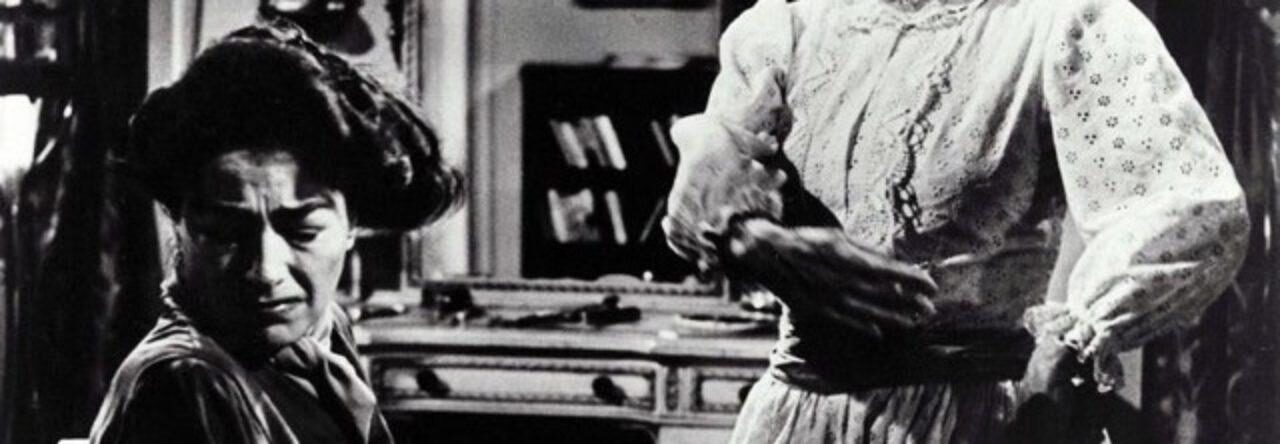
Look what the homosexuals have done to me!

Author: Cranky Lesbian Page 24 of 54

Cranky Lesbian is a disgruntled homosexual with too much time on her hands. Click for film reviews or to follow on Instagram.

Hedy Lamarr’s Ecstasy and Me: WTF?!

Does Hedy Lamarr’s Ecstasy and Me: My Life as a Woman contain the oddest introduction and preface in the history of autobiography? Ostensibly penned by her physician (a move you’d expect from Elizabeth Taylor), the introduction reads more like the work of Dr. Spaceman from 30 Rock (a Dr. Spaceman, it should be noted, who is on his best behavior), leading one to wonder just what Lamarr was up to when she inked a deal with Bartholomew House Publishers for the 1966 book she later claimed was ghostwritten, not to mention “fictional, false, vulgar, scandalous, libelous and obscene.” Perhaps she was distracted while working on her night cheese?

Lamarr, an actress better known for her beauty than her craft, had a turbulent personal life and rocky Hollywood career. Today she is best remembered as the co-inventor of spread spectrum technology, an innovation that paved the way for cellphones and wi-fi, but for many years her biggest claim to fame was her erratic behavior: she married often, dabbled in shoplifting (for which she was busted twice, once in the ’60s and again in the ’90s) and was litigious to the nth degree. Nearly 50 years after its first printing, Ecstasy and Me remains a lurid curiosity among celebrity tell-alls for its focus on the more, uh, sensual side of Lamarr’s life (her “life as a woman,” you see), and the introduction is intended to supply the whole sordid affair a veneer of respectability. Let’s take a look at it, shall we?

INTRODUCTION

I have been a physician for many years, treating many Hollywood personalities including Hedy Lamarr. I have come to the conclusion that in most cases there are enough demands and pressures on stars to cause any and every kind of physical breakdown.

An actress such as Miss Lamarr, who spent some thirty years in the hub of motion picture production and raised three children as well, can be thankful she survived the rough and treacherous grind at all.

Pills and alcohol are of temporary help for some motion picture stars in the battle against pressures, but the antidote is often worse than the poison.

Consider a Marilyn Monroe or a Dorothy Dandridge who may take an overdose of pills, whether accidentally or not. Or a Judy Garland who attempts suicide. It could be that their momentary depressions would pass and they would be happy the next day.

It is ironic that the very sensitivity required for talent is the cause of breakdowns.

Is there a real antidote for the kind of ambition that creates unquenchable drives? Yes. Though it may sound trite, other interests far removed from motion pictures can relieve the never-ending pressure.

It would seem to me that in this enlightened era, studio production heads would protect their valuable stars by making the filming of pictures easier for them. It may call for less shooting hours per dayin England there is no overtime workor better working conditions.

Stars have complained to me that much of their pressure, especially in television, builds up because scripts are usually being written and rewritten as they work. Certainly more expedient methods are possible without inhibiting the creative process.

From a medical point of view, I’d say that there are many important actressesand they are the most talented, and therefore the most susceptiblewho cannot, no matter how they are helped, withstand the nervous strain of picture making as it is done today. They should simply not be involved in it.

Now I’ve had my medical say. As for this book which I just finished reading, it is the most fascinating, revealing and honest life story I’ve ever read. It is a classic case of a talent who sacrificed the happiness of which she was capable, in exchange for fame and money. But then, who’s to say she was wrong?

j. lewis bruce, m.d.

“Who’s to say she was wrong?” indeed, Dr. Gossip (and no, Judy Garland wasn’t going to be happy the next day, not in a meaningful way, any more than Raymond Burr was going to be obese on a Thursday and slender by Friday). But wait, along comes the preface to make everything much weirder:

PREFACE

Whether in a passionate sexual encounter with a man who mistakes her for a prostitute, or in a cloak-and-dagger chase of high adventure, Hedy Lamarr’s responses as reported in ECSTASY AND ME appear to be blissfully unaffected by moral standards that our contemporary culture declares as acceptable.

She is an uninhibited spirit, unfettered by a code of conventional behavior, supremely conscious of the privilege and latitude the world bestows upon a superbly beautiful woman aware of her physical endowments.

ECSTASY AND ME is a story of the classic femme fatale for whom fame, fortune, and sexual excess are the inevitable fruits of great beauty on the make.

Miss Lamarr’s manifold sexual experiences, male and female, led her to the delightfully ingenuous self-prognosis that she is “oversexed.” Her admitted talent for quick and joyful orgasm indicates an uncomplicated natural sex response. Her curious search for new love-play settings and her candid delight in unexpected sexual episodes place her in a position of psychological unassailability. Not only does she possess a unique set of moral standards, but she expresses herself in a most intimate manner, in exquisite detail, and in the first person singular!

ECSTASY AND ME is an entrancing personal document as revealing as the contents of a girl’s locked diary. It is probably as good for Miss Lamarr’s psyche as it will be for many a guilt-ridden reader for whom this gutsy confessional may offer resultful therapy, if not instant emancipation.

philip lambert, psychologist

Dr. Philip Lambert, we’re told, was a Ph.D. who received his doctorate in Educational Psychology from the University of California (Berkeley) and was Chairman of the University of Wisconsin’s Instructional Laboratory and Director of its famed (according to Bartholomew Press) Synnoetics Center. That’s right, synnoetics. Google it and scratch your head.

In other words, he ejaculated mindless blather for a living and was trotted out like a William Castle gimmick to legitimize a salacious and most likely highly fictionalized account of a life that hardly needed any sensationalizing. And then, had he been a medical doctor, he might have made Hedy dance for happy shots or asked when medical science is going to find a cure for a woman’s mouthand it would still be less embarrassing than having your professional reputation attached to that strange preface.

P.S. Sadly I cannot, in the first person singular, report having been visited by feelings of “instant emancipation” after reading Ecstasy and Me, but I do seem to recall a Hilary Mantel piece in the London Review of Books about the erotic awakening she experienced after reading Florence Henderson’s autobiography, so if that’s what you’re after you might consider looking there.

Joan Crawford Slapping the Bejesus Out of People

Where has this video been all my life? To help you back to work after a three-day weekend, here’s a YouTube wizard’s tribute to Joan Crawford’s cinematic slaps set to the tune of Pat Benatar’s “Hit Me With Your Best Shot.”

Adventures in the Phil Andros Book Trade

Rare hardcover Guild Press edition of Stud by Phil Andros.

Considered objectively, the bed is a lonely battleground for attack and siege, assault and penetration. Of the two in combat, one is the victor, another the conquered. And once you are engaged on this battlefield, locked in mortal struggle until the miracle of the orgasm separates you from your opponentyou are absolutely alone.

phil andros, h2

Oh, he was apple-cheeked and black-haired and heterosexual, and I hated his gah-damned guts!

phil andros, the poison tree

Last year, after reading Justin Spring’s Secret Historian: The Life and Times of Samuel Steward, Professor, Tattoo Artist, and Sexual Renegade, I was so captivated by the unusual life of its subject that I began to hunt for his fiction: the hustler-centric gay erotica he’d written as Phil Andros and two mystery novels published as Samuel Steward that featured his friends Gertrude Stein and Alice B. Toklas as sleuths (the irresistible title of one: Murder Is Murder Is Murder).

When, after weeks of waiting, a cheap copy of STUD appeared online, I pounced. I expected to receive a 1980s paperback collection of short stories originally published in magazines in the early ’60s. What arrived instead was a hardcover of an earlier vintage, dust jacket still intact. The spine said “Guild Press.”

Steward’s unhappy experience with Guild Press and H. Lynn Womack, the interesting man who oversaw it, was still fresh in my mind from Secret Historian. Womack, described by Spring as “a heavyset Caucasian albino from a tenant-farming family in Hazelhurst, Mississippi,” had extensive business interests in the legally dicey publication and distribution of gay pornographic books and homoerotic physique magazines. Of his business entanglement with Steward, Spring wrote:

The situation with Womack and Guild Press was indeed about as bad as a book-publishing experience can be. Steward had expected $TUD would be published and available just a few months after his arrival in Berkeley, but Womack’s legal troubles were so severe that he had retreated into a psychiatric ward at St. Elizabeth’s Hospital in Washington, D.C., in order to avoid his creditors. From his improvised office in the hospital Womack could continue to run his business without restriction, but he had no money, and so $TUD was stuck in the warehouse without a binding. For the next three years Womack would evade all communication with Steward, leaving Steward unable to buy back the rights to his manuscript and incapable of publishing it elsewhere. Had the book been published in a timely manner, it might well have been recognized as a breakthrough in erotic publishing. But it had not been, and it would not be.

justin spring, secret historian: the life and times of samuel steward, professor, tattoo artist, and sexual renegade

Almost 50 years later, here was this doomed volume right in front of me. The surprises continued when I opened the book only to find that Steward himself had written inside of it.

Surprise inscription from Phil Andros in a Guild Press edition of STUD.

The inscription reads:

For Felice — a success, but the worst thing about that is you have to keep on being it. 

Phil Andros

Remember that hot night on top of the Empire State?

phil andros

Is there a better way for an author to sign a book than “Remember that hot night on top of the Empire State?” I’m going to do it one day just for kicks, bewildering a stranger in the process, as a way of honoring Sam, who died in 1993. It’s either that or start throwing gay sex parties at my house (a Steward specialty), and I don’t really have the physical equipment or social stamina for thator a stylish enough slipcover to preserve the integrity of my couch.

Joan Rivers Laughing As She Misspells “Vagina”

“Age, it’s the one mountain that you can’t overcome. It’s a youth society and nobody wants you. You’re too old, you’re too old, you’re too old. If one more woman comedian comes up and says to me, ‘You opened the doors for me.’ And I want to say, ‘Go fuck yourself. I’m still opening the doors.'”

joan rivers, joan rivers: a piece of work

To write that Joan Rivers has said some crazy shit over the years would be a massive understatement. When I see absurd headlines like “Joan Rivers Says Barack Obama Is Gay, Uses Trans Slur Against Michelle Obama” (and over the last several years there has been no shortage of them), my first reaction is to laugh at the sheer ridiculousness of it. But my second is to think, Of course she’d say that. After all, funny or not, there were few things Rivers wouldn’t say.

It would be easy to cobble together a post about the enmity this has earned her; just a cursory glance at Twitter last week on the day Rivers was rushed to the hospital in cardiac arrest revealed that people hate her for reasons ranging from comments she made about Palestinian children to jokes she made about Kristen Stewart. But reeling off enormously inflammatory and insensitive remarks with all the casualness of asking someone to pass the mustard is what Rivers did. She was a comedian, and a damn fine one at that.

In the documentary Joan Rivers: A Piece of Work (currently streaming on Netflix, along with the wonderfully weird 1973 TV movie she co-wrote, The Girl Most Likely to…), which follows its subject for a year as she frets about the central obsession of life—her career—Rivers stands before a wall of filing cabinets that contain over 30 years’ worth of typewritten jokes. Pulling an ancient-looking index card from a drawer labeled “Cooking—Tony Danza,” she reads, “Why should a woman cook? So her husband can say ‘My wife makes a delicious cake’ to some hooker?” dissolving into laughter at her own punchline. “And you wonder why I’m still working at this age,” she adds.

Joan Rivers flips through her fabled joke filing cabinet.

The question of why she never stopped working is answered time and again in A Piece of Work, which was directed by Ricki Stern and Annie Sundberg: She equates not working with death. “I don’t want to retire,” she says. “I don’t want to go and sit in the sun. I don’t want to go and learn to garden. I paint. Who cares?” As her agent puts it, “She hears the clock ticking every minute of every hour of every day.”

Early in the film, she sits with her assistant to discuss scheduling. There’s nothing Rivers hates more than knowing her appointment book is empty, and she thumbs through dog-eared day planners from years past with satisfaction, declaring, “Now that’s a good page. You know what I mean? These are good pages. 10:00, 11:00, 12:30, this and that. That’s happiness. Last year was a very difficult year. I was playing, here we go, the Bronx at 4:30 in the afternoon. That was a real… good one.” The memory upsets her.

“I’ll show you fear,” she says, and holds up a planner with blank pages. “That’s fear. If my book ever looked like this, it would mean that nobody wants me and that everything I ever tried to do in life didn’t work. Nobody cared and I’ve been totally forgotten.”

Rivers looks for drama in her appointment book.

Much of the drama in A Piece of Work is manufactured: Despite Rivers and her manager and agent variously describing her career as being “in the toilet” and “in a slump,” she was as busy as ever. Her claims of money woes were also preposterous—her business empire is ignored here. Rather, the focus is on standup engagements, appearances on The Celebrity Apprentice, and her eagerness to land endorsement deals. “I will do anything,” she offers. “I will knock my teeth out and do, uh, Dentisure or whatever it is. I will wear a diaper. I don’t give a shit.”

But that is part of the film’s charm. Rivers’ ambition was always to be an actress, she explains, and doing standup at night was just a way to bankroll her craft. That her comedy eclipsed her acting was how the cookie crumbled, but acting remained her true love and the failure of Fun City, a play she co-wrote for herself in 1970, still haunted her decades later. If people want to insult her comedy, she says, that’s fine with her, but not her acting. Finally she pronounces, and you know she’s telling the truth, “My career is an actress’s career. I play a comedian.” 

And so she did, in life and in A Piece of Work, in which the role she selected for herself was that of a woman with the odds stacked against her. “Right now they see her as a plastic surgery freak who’s past-due her, you know, sell-by date,” her manager opines. “But God help the next queen of comedy, because this one’s not abdicating… never will. There’ll be nail marks on that red carpet before she abdicates. So good luck to the next queen.”

A laughing Joan Rivers struggles to spell “vagina” correctly.

The great fun of the film is watching Rivers play that part and seeing her work on her comedy. In one of my favorite scenes she scrawls notes about jokes she might want to perform at an upcoming show, cracking herself up all the while (and misspelling the word “vagina”). A septuagenarian at the time, she looks more like a mischievous third-grader as she delights in such rude possibilities as “Are gay men proud of their excessive body hair? Like Madonna’s daughter?” and “Amazing Race: Mel Gibson chasing Jews into the showers.”

A more poignant moment comes at the end, when Rivers ponders the future. “Don Rickles is in his late eighties and he is still hilarious,” she observes. “He’s like George Burns, who was amazing until he was in his late nineties. And Phyllis Diller, until she was 92, she just laid it down. And I’d like to beat them all. And I think I will. That’s what’s so sick. I think I will.”

Disclosure: As an Amazon Associate I earn a small commission from qualifying purchases.

A Terribly Important Quote from Edie: An American Girl

As a companion piece of sorts to “A Touching Tale of Truman Capote’s Hatred of Gore Vidal,” I submit without comment my favorite quote from another George Plimpton oral history:

“I can tell you, I’m nearly the last person in the world who
would ever consider doing a sex scene for a movie in a rubber raft in the middle of an indoor swimming pool at the health club.  But that’s the way we wound up with it.”

Richie Berlin in Edie: An American Girl, by Jean Stein and George Plimpton

Wait, I lied, I do have a comment: If you read their autobiographies, a lot of DeMille actresses shared similar stories. 

Ivy Compton-Burnett’s Love for Margaret Jourdain

You can’t understand Ivy Compton-Burnett without understanding her love for her partner, Margaret Jourdain.

“Anyone who picks up a Compton-Burnett finds it very hard not to put it down.

Ivy Compton-Burnett to Elizabeth Sprigge

Compton-Burnett, capable of making any reader’s brain ache in 100 words or less, died on this day in 1969. Legendarily dour, and one of my favorite writers, she was as uncompromising in her work as in her personal life. She knew her characters so well—their quandaries, quarrels, and especially their conversations—that she saw no point in slowing down to explain them to the rest of us.

She once told Jourdain, “I do not see why exposition and description are a necessary part of a novel.” This explains why, in some strange way, you don’t read Compton-Burnett’s novels so much as they happen to you. It’s a bit like being thrown into a bottomless lake and left to fend for yourself in the dark. Foreign, potentially sinister objects might brush against your skin, while, overhead, emotionally crippled people say devastating things to each other. (Some of you might call that ‘the holidays.’)

Pervy Shit Charlie Said to His Angels: Part 1

The Angels fight crime but tolerate sexual harassment in the workplace.

Recently, for reasons best left between me and the God of your choice (Bea Arthur works for me), I made a major life decision to watch all five seasons of Charlie’s Angels in its entirety. 

My familiarity with Angels was so scant that I had few expectations, but one thing I wasn’t prepared for was the grossness of Charlie himself. Okay, sure, the show’s reputation for having an “LOL, boners” sensibility preceded it (everyone’s heard of “jiggle TV”), but who would expect a speakerphone to be pervy?

Inside Rielle Hunter’s Illicit Love Affair with Salad

Ahem: “John Edwards, Salad, and Me.”

If you were unfortunate enough to read Rielle Hunter’s What Really Happened: John Edwards, Our Daughter, and Me (I didn’t have much choice; some things in life are beyond our control), the first thing you probably noticed is that she’s an absolute idiot. The second is that she loves salad.

With each new chapter of this slender but not slender enough volume, it seems she’s traveling to yet another dreary hotel for an assignation with Edwards. (She calls him “Johnny” almost as relentlessly as she eats salad, for “Johnny” is what’s on his birth certificate and thus most representative of his true self. If you search the Kindle edition of her book for “Johnny,” the device will pant and wheeze before the results exceed 500 and it stops counting.) He is so busy with campaign commitments and marital spats that a bored Hunter has no choice but to console herself with salad. Lots of salad.

Let’s stroll with her down a lettuce-strewn memory lane, shall we, and revisit these tender scenes from her past.

The Time Nancy McKeon Got Schizophrenia

Recently I was minding my own business, looking for something to watch on Netflix, when I did what everyone who has been in a similar situation has done at one time or another and entered “Valerie Harper” in the search bar. Recommended was not Rhoda, sadly (or, less sadly, Night Terror), but an unfamiliar title called Strange Voices.

The plot description of this 1987 telefilm didn’t sound too promising: When their college-age daughter suddenly begins acting erratically and is diagnosed with schizophrenia, a desperate couple seeks treatment for her. But the casting was enough to catapult any TV movie into the category of “viewing as essential as Children of Paradise and Battleship Potemkin,” for this very special story starred Valerie Harper as one-half of that desperate couple and Nancy McKeon as her daughter.

Misty watercolor memories of the way they were.

Martina and Chrissie, As Reflected by Their Tweets

Note: This is an eight-year-old post that was accidentally set to ‘private.’ It’s not new or even worth reading!

And now, as the U.S. Open approaches, a post that won’t make sense to anyone unfamiliar with BFFs/former arch-rivals Martina Navratilova and Chris Evert.

Both women are on Twitter, where their musings appear to accurately reflect their personalities: Martina is uber-political and might link to New York Times articles more often than official New York Times Twitter feeds; Chris frequently mentions her family, compliments her colleagues, and has flirted with Scott Foley of TV’s Scandal. She’s been known to retweet photos of butterflies and mantras that inspire Wynonna Judd. Let’s take a look at some of their tweets.

Page 24 of 54

Powered by WordPress & Theme by Anders Norén