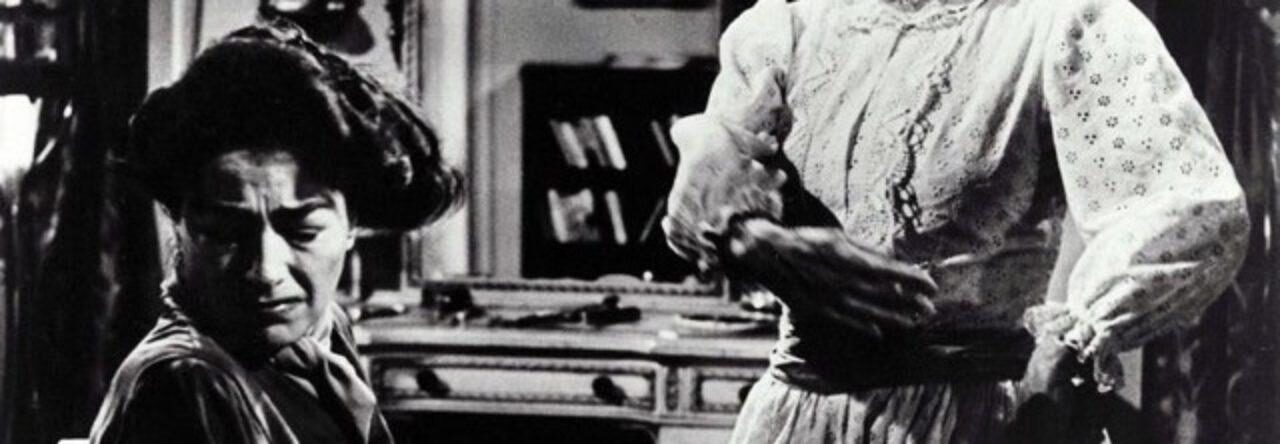
Look what the homosexuals have done to me!

Author: Cranky Lesbian Page 11 of 54

Cranky Lesbian is a disgruntled homosexual with too much time on her hands. Click for film reviews or to follow on Instagram.

Dial ‘M’ for Murder: The Angie Dickinson Remake

Angie Dickinson with Ron Moody in Dial ‘M’ for Murder.

Onscreen adultery rarely looked more glamorous than when it was being committed by Angie Dickinson, who followed her turn as one of the more significant straying spouses in the history of cinema—in Brian De Palma’s 1980 classic, Dressed to Kill—with a TV remake of another notable tale of extramarital betrayal, Dial ‘M’ for Murder. In an intriguing departure from other adaptations of Frederick Knott’s stage play, Dickinson was 50 years old when she tackled the role of Margot Wendice—twice as old as Grace Kelly, who played Margot in Alfred Hitchcock’s Dial ‘M’ for Murder (1954).

That Dickinson’s Margot and Christopher Plummer’s Tony Wendice are an age-appropriate pairing subtly reconfigures their power dynamic. Grace Kelly’s youthfulness, contrasted with the Ray Milland’s cool, mature composure as a retired tennis player, enhanced her character’s vulnerability. In Andrew Davis’ A Perfect Murder, a 1998 remake, Gwyneth Paltrow would’ve been more believable as the daughter, not wife, of an embattled Michael Douglas. Dickinson, who held her own in westerns, exploitation flicks, police fare, and opposite the Rat Pack, was no ingénue by 1981, raising the domestic stakes.

Kate Jackson Makes the Grade in Satan’s School for Girls

Kate Jackson leads a campus recruitment effort in Satan’s School for Girls.

Nearly 50 years after its television debut, Satan’s School for Girls (1973) owes much of its timelessness to Kate Jackson’s devious smile. But it’s strikingly modern in other ways as well, containing portents of the #MeToo movement and alluding to the continued (and comically one-sided) political debate about the merits of a liberal arts education.

We join the action as Martha (Terry Lumley), paranoid in the manner of an Afterschool Special character lost in a bad trip, races to her sister Elizabeth’s place. There she encounters an offscreen menace and is soon found hanging from the rafters. Elizabeth (Pamela Franklin) knows it wasn’t a suicide, despite police labeling Martha “a melancholy girl,” and enrolls at Martha’s alma mater, the Salem Academy for Women, to conduct an undercover investigation.

Teen Witch: Go and Top (or Bottom) That

Mandy Ingber and Robyn Lively in Teen Witch.

As its theme song warns—or perhaps threatens—you’re never gonna be the same again after watching Teen Witch (1989). The phrase is emphatically repeated no fewer than 17 times in the track that accompanies the film’s baffling opening sequence, which plays like a ponderous perfume ad aimed at tweens. When that sonic nightmare is finally over, 15-year-old Louise Miller (Robyn Lively) awakens to find her little brother, Richie (Joshua John Miller), binge-eating junk food beneath her bed.

It is as difficult to convey Richie’s essential gayness as it is burdensome to adequately describe the many tortures of the Teen Witch soundtrack. Louise will soon learn, on the cusp of her sixteenth birthday, that she is a witch poised to assume control of her powers. But to focus solely on her supernatural gifts is to overlook the flaming young Richie’s demonic possession by the spirits of Paul Lynde and Alice Ghostley. Zelda Rubinstein plays Madame Serena, Louise’s mentor in mischievous magic, and I kept imagining her Poltergeist character spotting Richie and chanting “Cross over, homos. All are welcome!”

A Heritage of Infamy: Pulp Art and Movie Posters

A sapphically-oriented guest bedroom nook.

It’s been a hectic week here, with my wife wrapping up a grant as I’ve prepared for company. When your homophobic in-laws are coming to inspect your new-ish digs for the first time, you want to pull out all the stops, which in my case meant framing some old gay pulp fiction paperback art for their viewing displeasure. Guest bedroom window nooks are now home to Daughters of Sappho (“A Heritage of Infamy!”) and Lesbian Queen (“Crowned campus queen, she chose to rule a small, hot female realm of off-beat lust”).

There are male-centric prints (like Gay Cruise) in the room currently serving as our gym, and of course men were the centerpieces of the pulp art in my previous home, where Hot Pants Homo was framed on the refrigerator alongside a dramatic photo of Jane Bowles. The Hot Pants Homo tagline is a doozy: “Women lusted after this handsome, virile jazzman… It took him years of agony to realize he wanted a man.” Wherever we live, the guest bathroom’s the same, featuring a large Gay Traders, a soapy visual feast where the naked women seem like more of a group-shower afterthought. “The trouble with swap is where to stop!” it warns. Who knows what the plumber thinks we’re up to.

Kate Jackson Does Time in Inmates: A Love Story

Killer Bees were nothing compared to hard time.

Kate Jackson’s incarcerated again in Inmates: A Love Story (1981), and while it’s frustrating that her love interest is Perry King and not Meg Foster, we must learn to accept it and move on with our lives. (Gluttons for punishment will recall that Foster was King’s lesbian love interest in 1978’s seven-layer dip of offensiveness, A Different Story, in which he also played gay, but that’s a rant for another day.) If you can manage your disappointment, even as Jackson wears flannel and finds herself on garbage detail, you’ll be rewarded with a bizarre, mostly enjoyable telefilm with a rare early ’80s lesbian subplot.

Jackson’s Jane Mount (no comment on the butch surname) is doing “a nickel to a dime,” as she puts it, at the Greenleaf State Co-Correctional Institution, an experimental coed facility. The men and women bunk in separate areas but fraternize in the cafeteria, prison yard and other shared spaces. Sexual contact is a verboten but couples pair off anyway, which is how Jane’s closest friend, young Grace (an affecting Fay Hauser), becomes pregnant. When Grace spots the baby’s father canoodling with another inmate, Jane tells her to leave and approaches the cad with her cafeteria tray — and a trademark mischievous Jackson smile that signals he’s about to receive a helluva comeuppance.

Quick Programming Note for Kate Jackson Fans

Kate Jackson, affectionately known here as Charlie’s Butchest Angel, celebrates a birthday later this month. If time permits I plan to look back on a few of her telefilms. First up will be Inmates: A Love Story (from 1981, the same year as Thin Ice), in which she again finds herself behind bars, this time in a co-ed institution with Shirley Jones as the prison superintendent.

Will sparks fly when the impossibly handsome Perry King shows up in a three-piece suit as a white collar criminal? Why is Tony Curtis loitering near the men’s showers dressed like a cross between a pimp, a cat burglar and the Gorton’s fisherman (by way of Johnny Cash)? We’ll attempt to answer all these questions and more next week, but I wanted to put this here now as a promise. Because, through a convoluted and predictably gay series of events, a few Jackson fans check in here almost every weekend looking for new Kate content.

Finally, an update on last week’s post about my anniversary. My wife and I don’t normally exchange gifts but since this was a milestone year I gave her a painting of the place where we got engaged. She gave me a Tom of Finland book that some of you will surely appreciate. Now the question becomes whether to leave it on the coffee table when her super-religious parents visit next week.

UPDATE: Here’s the Inmates: A Love Story review.

The Deliberate Stranger: Before There Was Netflix…

Mark Harmon in The Deliberate Stranger (1986).

Netflix, the streaming giant once poised to join or overtake HBO as a premiere destination for prestige programming, now happily wallows in lurid filth—and, sadly, I don’t mean that in the best spirit of the phrase. Whether it’s the new Marilyn Monroe film (which I’m avoiding for reasons better articulated by Michael Campochiaro of The Starfire Lounge), or an endless parade of deeply exploitative true crime ‘documentaries’ that aren’t worthy of the name, I regularly receive promo emails from Netflix touting irredeemable content.

Monster: The Jeffrey Dahmer Story, one of its most recent ghoulish offerings, is produced by Ryan Murphy, a titan of tabloid tragedy who has never met a murder he wasn’t happy to exploit for profit. Even as real-life families of victims called the series re-traumatizing, it was quickly watched in its entirety by more than 56 million households. I’ve heard more than one viewer justify their decision by insisting they’re merely interested in abnormal psychology, which is absurd. No one is bingeing a 10-part series about a cannibal weeks before Halloween for academic reasons.

I Think I’m Having a Baby: A Teen’s Pregnant Pause

Jennifer Jason Leigh, dressed in a red shirt, waves.
Jennifer Jason Leigh waves goodbye to her childhood in I Think I’m Having a Baby.

As strange a title as it is — it’s preferable to possess a degree of certainty about whether you’re expecting — I Think I’m Having a Baby is also perfectly in keeping with the utter cluelessness of this 1981 Afternoon Playhouse special’s 15-year-old protagonist. Laurie McIntire (Jennifer Jason Leigh), a child with the hair and makeup of a divorced and disillusioned single mother of two, has entered that hideous phase of adolescence where she’s constitutionally incapable of doing anything but mooning over an unimpressive boy.

Star athlete Peter (Shawn Stevens) dates her older cousin Phoebe (Helen Hunt), whose preppy sweater draped over the shoulders tells you all there is to know about her. Peter isn’t particularly bright (Phoebe does his schoolwork) and teases Laurie on the rare occasion he notices her at all. But when her best friend Marsha (Bobbi Block, now known as Samantha Paris) and little sister Carrie (Tracey Gold, years away from the torments of Lady Killer and Midwest Obsession) mock his ape-like walk across the football field, Laurie gets defensive. “He’s not really like that,” she insists.

Love, Soft as an Easy Chair

Barbra Streisand asks the eternal question in A Star is Born.

I have a thing about A Star is Born. Not the 1937 Janet Gaynor original or George Cukor’s 1954 musical remake starring Judy Garland, though I’ve seen both. It’s the worst of the bunch, the misconceived 1976 lovechild of Barbra Streisand and Jon Peters, that I love unabashedly, even though it’s a top-to-bottom disaster. (Was there anything about its conceptualization of Esther that wasn’t completely deranged?)

The excesses and eccentricities of that iteration of A Star is Born were at the forefront of my mind in 2018, as the October release of Bradley Cooper’s remake drew near. I almost revived this website, long-dormant at the time, to discuss it. Part of what drove me crazy was that my wife was unfamiliar with every telling of the story and couldn’t pretend to understand my excitement.

The Golden Girls: “On Golden Girls” Episode Recap

Blanche Devereaux is a woman of many skills—most notably, some that are impolite to discuss publicly—but it’s fair to say exemplary parenting and grandparenting weren’t among them. She acknowledges strained relationships with her (many) children more than once in the course of The Golden Girls, but we rarely see her do anything about it.

In “Even Grandmas Get the Blues” (S6E20), she pretends granddaughter Aurora, Rebecca’s baby, is her own to impress a potential suitor (Alan Rachins). A few episodes later, in “Beauty and the Beast” (S7E03), granddaughter Melissa comes to visit and Blanche forces the resentful child to participate in a pageant for her own vain reasons. As in her dealings with sister Virginia, Blanche focuses on herself to the exclusion of others, but it wasn’t always that way.

Page 11 of 54

Powered by WordPress & Theme by Anders Norén